🚨 What the Clause Says
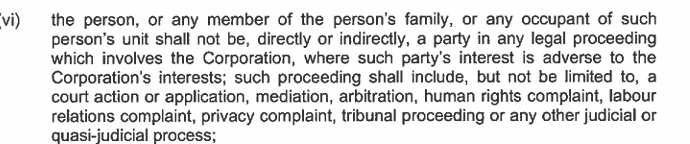
In simple terms, this means:
- If you’ve ever filed a case, complaint, or application against the condo you, your family, or even your tenant – you are banned from serving on the board.
🧨 Why This Clause Is Flat-Out Illegal
1️⃣ It Violates the Condominium Act, 1998
The Act clearly defines when a person can be disqualified as a director.
Section 29(2) states that a person ceases to be a director only if they are:
(a) bankrupt,
(b) incapable of managing property,
(c) found incapable by a court,
(d) in arrears of common expenses for 90 days,
(e) failed to complete required training, or
(f) failed to make required disclosures.
— Condominium Act, 1998, S.O. 1998, c. 19, s. 29(2)
That’s it.
Nowhere does the law say that being a party to a legal, tribunal, or human rights proceeding disqualifies someone.
👉 Therefore, any by-law that tries to add new disqualifications is ultra vires – meaning beyond the corporation’s legal power.
Condo boards cannot rewrite provincial law.
2️⃣ It Violates the Ontario Human Rights Code
Section 8 of the Human Rights Code states:
“Every person has a right to claim and enforce his or her rights under this Act… without reprisal or threat of reprisal for so doing.”
— R.S.O. 1990, c H.19, s. 8
This by-law explicitly punishes anyone who has ever filed a human rights complaint or stood up to discrimination – which is the very thing the Code protects you for.
It’s not just wrong; it’s reprisal, which is illegal under section 8 and 9 of the Code.
3️⃣ It Contradicts the Canadian Charter of Rights and Freedoms
While condominiums aren’t “government,” their by-laws must still align with public policy and Charter values, including:
- Section 7: the right to security of the person and fundamental justice;
- Section 15: the right to equality before and under the law.
Punishing someone for using lawful judicial or human rights processes violates those principles.
Access to justice and equality before the law are foundational Charter rights.
A condo board cannot erase them with a by-law – no more than a school or employer could.
4️⃣ It’s Textbook Retaliation
Let’s call this what it is: revenge in legal clothing.
The message is simple
“If you ever held us accountable, you’ll never serve again.”
That’s retaliation, pure and simple.
Retaliation is prohibited under:
- the Human Rights Code (s. 8),
- the Condominium Act’s oppression test (s. 135), and
- basic principles of natural justice.
💬 In Plain English
This by-law is the legal equivalent of saying:
“If you ever sued your employer for discrimination, you’re banned from working here again.”
That’s vindictive, unconstitutional, and unenforceable.
No court or tribunal would uphold it.
🔚 Bottom Line
- It breaks the Condominium Act by inventing new disqualification rules.
- It violates the Human Rights Code by retaliating against anyone who asserted their rights.
- It offends the Charter values of equality and access to justice.
- It’s a retaliatory weapon, not a code of ethics.
