People love this question because they think it has a morally impressive answer.
It doesn’t.
It has an honest one.
🐾 The Question Everyone Pretends Is Hypothetical
“If there’s a fire, who would you save – your pet or your neighbor, the one you occasionally say hi to?”
Most people rush to say the neighbor. Not because they’ve thought it through – but because they want to sound decent.
That answer is about optics, not ethics.
🐶 What Responsibility Actually Means
A pet is not a preference. It is a responsibility.
You chose that animal. You brought it into your life. You became its entire safety net. It depends on you for food, shelter, protection – and survival.
Your neighbor does not.
Saying hello in the hallway is not a moral contract. It does not make you someone’s guardian, rescuer, or last line of defense.
Moral obligation is not evenly distributed. It is assumed.
🧭 Why the Honest Answer Makes People Uncomfortable
Saving your pet feels “selfish” only because we’ve been trained to confuse morality with performance.
But real ethics isn’t about sounding noble after the fact. It’s about duty in the moment.
Abandoning a being who depends entirely on you is not virtuous. It’s a betrayal.
Saving a stranger is admirable. Saving someone you are responsible for is mandatory.
Those are not the same thing.
⚖️ What Ontario Law Quietly Understands
Under Ontario law, there is no general legal duty to rescue a stranger.
You are not required to endanger yourself, calculate moral hierarchies, or prioritize one life over another simply because someone is human. Legal responsibility arises only where a duty of care already exists – for example, toward a child, a dependent, or someone whose risk you created.
A pet is a life you have voluntarily assumed responsibility for. That responsibility is concrete, ongoing, and legally recognized in multiple contexts (care, control, and protection of animals).
Ontario law does not rank lives. It ranks duties.
In an emergency, choosing to save a being you are legally and morally responsible for – rather than a stranger – is not criminal, reckless, or unlawful.
That’s not sentiment. That’s the structure of the law.
🤝 The Good Samaritan Act (What It Does – and Doesn’t)
Ontario’s Good Samaritan Act is often misunderstood.
It protects people who choose to help from being sued for ordinary mistakes made in an emergency, as long as they act in good faith. It encourages assistance by reducing fear of liability.
What it does not do:
- It does not force anyone to help.
- It does not tell you who you must help.
- It does not criminalize choosing one rescue over another.
The Act shields helpers. It does not conscript them.
If you act – imperfectly, under pressure – the law gives you room to be human. If you choose between limited options, the law does not second‑guess your triage.
🕊️ Why I Answer Without Apology
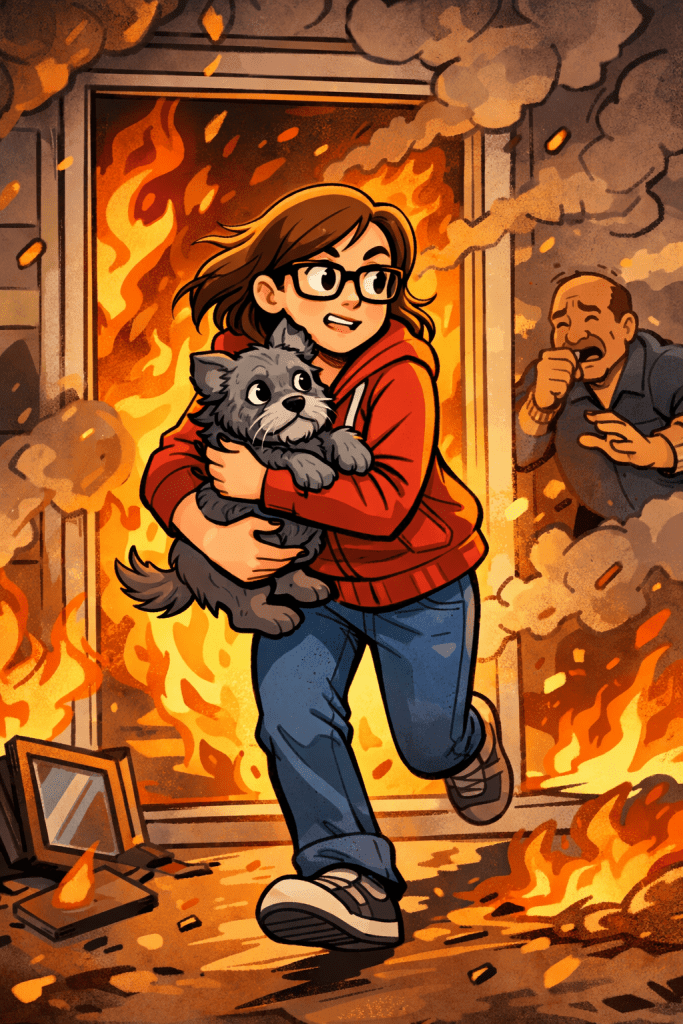
I would save my pet, Murphy, again, and again. And without hesitation.
Not because an animal is “worth more,” but because that life is mine to protect.
My pet would not understand fire alarms or escape routes. It would wait for me.
And I would not leave.
If that makes some people uncomfortable, that discomfort belongs to them – not to me.
🧠 The Quiet Truth Beneath the Question
People who insist there is only one “correct” answer usually believe morality is abstract, clean, and reputational.
I don’t.
I believe morality lives where responsibility does.
And sometimes, that responsibility has four legs, trusts you completely, and follows you without question – even into smoke. Leaving that being behind is not moral sophistication. It is abandonment
That’s not sentimentality. It’s integrity.
👉 If you believe your rights have been violated, contact us confidentially through the Condo Leak Tipline at www.CondoTribune.com/tipline – your story matters, and you’re not alone.
📝 While we are not lawyers, we’ve spent years learning the Condominium Act, tribunal process, and case law – and we’re here to help point you in the right direction.
Disclaimer: This post is for general information purposes only and does not constitute legal advice. For legal guidance specific to your situation, please consult a qualified lawyer.
