A Field Study in Folding-Table Authority
📜 Abstract
This paper examines the curious psychological transformation that occurs when an otherwise ordinary resident acquires minor administrative authority within a mid-sized Ontario condominium corporation.
Particular attention is given to three documented phenomena:
- 📋 The Clipboard Effect
- 📧 Email Signature Inflation Disorder (ESID)
- 🏛 The “We’ve Always Done It This Way” Reflex
Preliminary findings suggest that laminated agendas may induce disproportionate self-importance.
📋 I. The Clipboard Effect
📌 Definition
A rapid escalation in perceived authority following physical contact with a clipboard, binder, or stapled agenda.
🔬 Observed Symptoms
- Standing while others remain seated
- Beginning sentences with “For the record…”
- Referring to oneself in the third person as “the Board”
- Sudden fascination with Robert’s Rules of Order
Before clipboard:
“Lovely weather.”
After clipboard:
“I will now call this meeting to order.”
Researchers conclude that the clipboard functions as a psychological exoskeleton, allowing its holder to believe they are presiding over Parliament rather than a carpeted party room beside a treadmill.
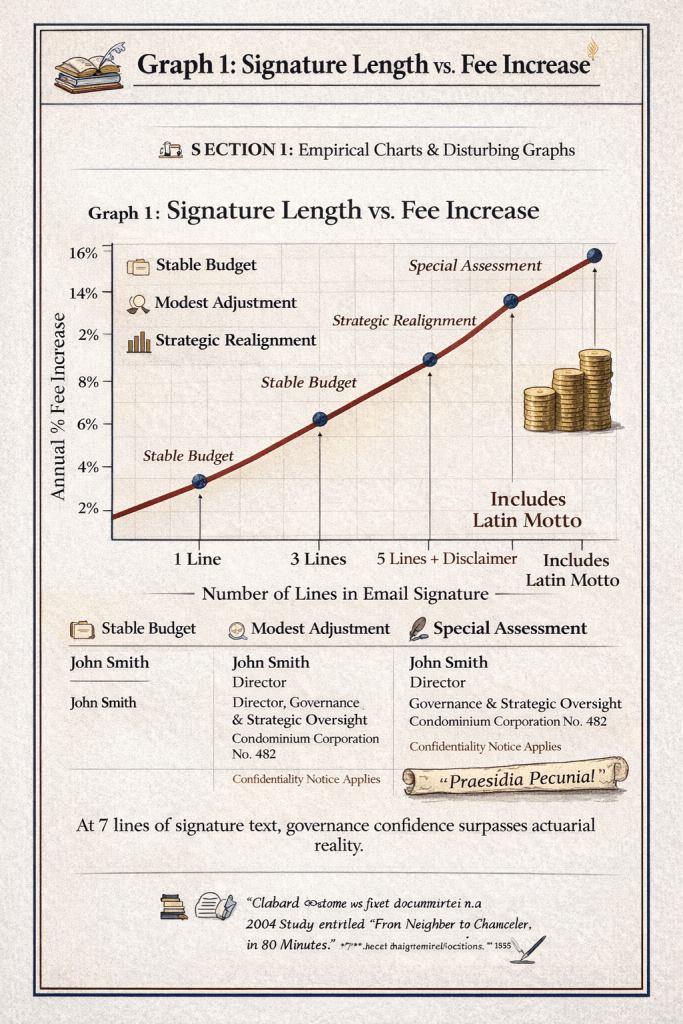
📧 II. Email Signature Inflation Disorder (ESID)
📌 Definition
The progressive expansion of one’s email signature following election to a volunteer board position.
🧾 Clinical Stages
Stage 1:
John Smith
Stage 2:
John Smith
Director
Stage 3:
John Smith
Director, Governance & Strategic Oversight
Condominium Corporation No. 482
Stage 4:
Signature longer than the email itself, including legal disclaimers normally reserved for international banking institutions.
Common verbal companion:
“As a board member…”
No known cure exists, although exposure to an audited financial statement may cause temporary reduction in font size.
🏛 III. The “We’ve Always Done It This Way” Reflex
📌 Definition
A defensive neurological response triggered by the suggestion of improvement.
🚨 Common Triggers
- “Have we benchmarked against similar buildings?”
- “Why are our fees higher than neighbouring properties?”
- “Could we review the contract terms?”
🛑 Standard Response
“We’ve always done it this way.”
The reflex functions as a cognitive seatbelt – preventing new information from entering the governance vehicle.
Long-term exposure leads to:
- 📈 Gradual fee creep
- 🧾 Deferred maintenance
- 📊 Suspicion of spreadsheets
💼 IV. The Confidence–Competence Inversion
📌 Definition
A measurable gap between certainty and experience.
Individuals with limited exposure to:
- Multi-year capital forecasting
- Infrastructure depreciation modelling
- Insurance risk assessment
- Regulatory compliance
Often display exceptional decisiveness.
Meanwhile, qualified professionals use dangerous phrases such as:
“It depends.”
Owners frequently mistake volume for expertise.
Markets do not.
☕ V. The AGM Coronation Ritual
Field studies confirm that petty power is typically acquired under the following environmental conditions:
- Fold-out tables
- Slightly warm bottled water
- A tray of untouched cookies
- Fluorescent lighting
The ceremonial phrase:
“Is anyone willing to serve?”
Functions as the constitutional anointment.
Applause follows.
And thus begins stewardship over assets exceeding eight figures.
No prior governance training required.
Just availability.
📊 VI. Economic Consequences
While each condition may appear benign in isolation, the combined effect produces measurable financial outcomes:
- 📈 Inflation rebranded as prudence
- 🏗 Maintenance reclassified as “strategic deferral”
- 💰 Fee increases described as “modest adjustments”
Owners express surprise.
Spreadsheets do not.
🧾 Conclusion
Petty power is rarely malicious.
It is earnest.
It is procedural.
It is laminated.
The difficulty lies not in bad intent, but in scale.
The scale of responsibility far exceeds the scale of preparation and competence.
Folding tables collapse neatly at the end of the meeting.
Financial consequences do not.
