How Fear of Truth Turns Communities Into Monsters
Mary Shelley wrote Frankenstein in 1818 – a story about what happens when society rejects what it doesn’t understand.
Two centuries later, the setting isn’t a Gothic castle.
It’s a condominium.
The creature isn’t made from dead bodies – it’s made from facts, evidence, and uncomfortable truths.
🧠 Act I: The Creation
Frankenstein’s creature was born from intellect and courage – the will to see what others refuse to see.
That’s what truth-tellers do. They stitch together pieces – the missing financials, the contradictions, the records, the numbers in parentheses – until the real picture emerges.
But once the creature came alive, the very people who should have celebrated the breakthrough recoiled in horror.
They didn’t want discovery – they wanted comfort.
Just like here:
When someone dares to say, “The operating account is in overdraft,” or “The board breached its duty of care,” the mob doesn’t check the ledger – it checks its torches.
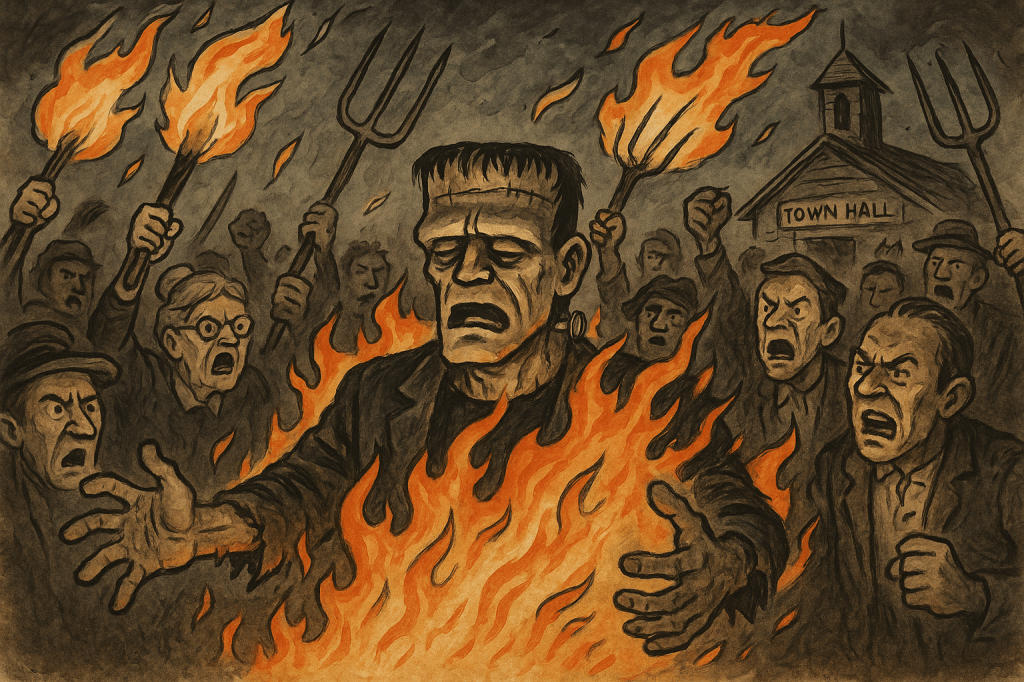
🔥 Act II: The Mob
Shelley’s villagers didn’t stop to ask questions.
They didn’t want to understand the creature – they wanted to eliminate it.
Fear of difference became a group sport.
That’s exactly what happens when a community, instead of facing its own mismanagement, rallies around gossip and scapegoating.
Rather than ask, “Why is the corporation in deficit?” they ask, “Who keeps bringing this up?”
They mistake the messenger for the problem.
The mob finds relief not in facts, but in condemnation.
🪞 Act III: The Real Monster
Frankenstein abandoned his creation, and the mob hunted it down.
But the true horror wasn’t the creature’s existence – it was society’s reaction to it.
In our story, the board created the dysfunction – the secrecy, the hostility, the financial decay, the lies.
Then, when someone finally pointed to the stitches, they shouted: “Look, a monster!”
They lied about overdrafts, disguised deficits as “timing issues,” and silenced the person who refused to pretend.
They feared exposure more than failure.
⚖️ Act IV: The Moral
Frankenstein’s creature didn’t want to destroy – he wanted to be heard.
He begged for fairness, for understanding.
When that was denied, he became what they accused him of.
That’s what happens when a system punishes truth-telling – it breeds resentment, resistance, and rebellion.
The creature becomes stronger, not weaker.
And sooner or later, it turns back to face its creator.
💡 Final Reflection
Frankenstein is not a horror story – it’s a warning.
When reason is exiled and ignorance rules, communities destroy their own saviors.
At WNCC 37, the torches aren’t literal – they’re votes, gossip, letters, and whispers.
But the result is the same:
A mob chasing the truth through the village square, screaming, “How dare you show us what we’ve done.”
