A very close friend of mine recently died.
In the days that followed, his friends were trying to do what friends do when someone they love is gone. We were searching for family members, arranging a funeral, gathering photographs, preserving his belongings, and trying to ensure that he would be laid to rest with dignity.
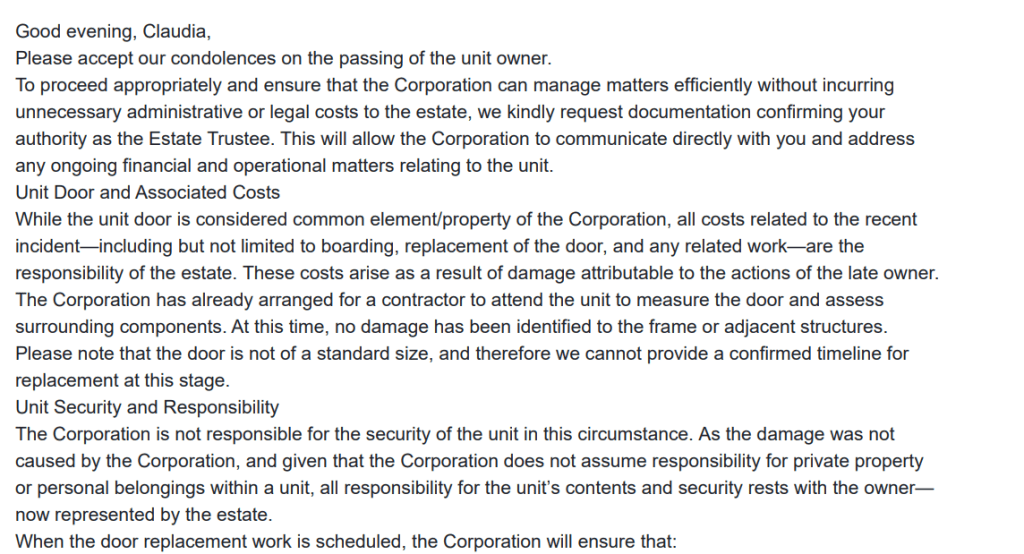
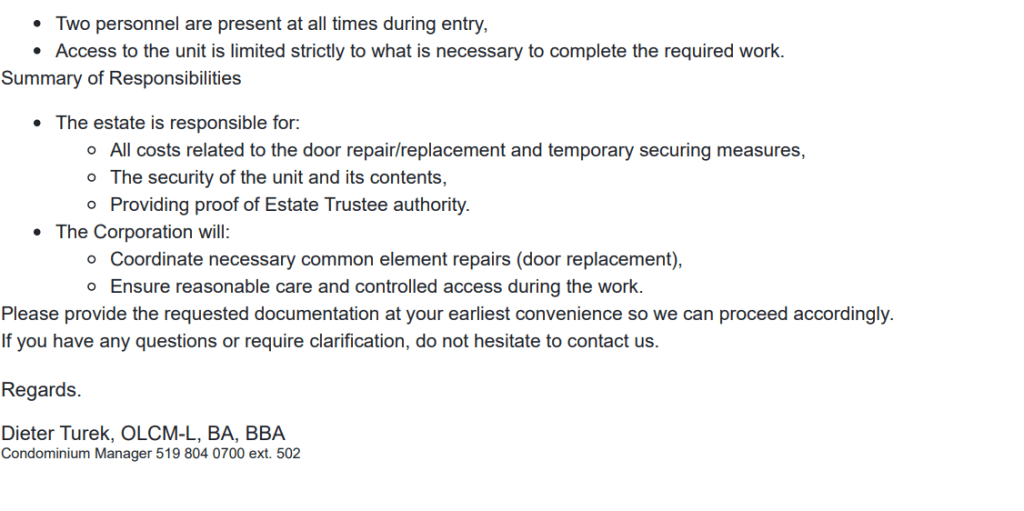
In the middle of that process, we received the following email from a condominium manager.
I am publishing it in full because I believe it deserves to be read exactly as written.
📧 The Email
🎓 A Lot of Credentials. No common sense
Let’s take a moment to appreciate the signature.
OLCM-L, BA, BBA.
That is an impressive collection of letters.
Unfortunately, none of them appear to stand for:
✔ Compassion
✔ Empathy
✔ Humanity
✔ Bereavement Awareness
✔ Basic Human Decency
⏱ Condolences That Lasted Exactly One Sentence
The email begins with:
“Please accept our condolences on the passing of the unit owner.”
A reasonable person might expect that what follows would recognize the circumstances.
That perhaps there would be some acknowledgment that a human being had died.
That friends were grieving.
That funeral arrangements were still being made.
That people were doing their best to navigate one of the most difficult weeks of their lives.
Instead, the very next discussion is about:
💵 Administrative costs
💵 Legal costs
💵 Door costs
💵 Security responsibilities
💵 Estate obligations
Apparently the condolences expired after the first paragraph.
🚪 The Door Became the Main Character
A very close friend dies.
His friends are trying to arrange a funeral.
And somehow the emotional centre of the email becomes a condominium door.
The word “door” appears repeatedly.
The words “grief,” “mourning,” and “funeral” do not appear at all.
There is concern about measurements.
There is concern about responsibility.
There is concern about liability.
There is concern about costs.
There is no concern expressed for the people left behind.
But don’t worry.
The door has been measured.
🧊 “The Actions of the Late Owner”
Let’s pause for a moment and appreciate this sentence:
“These costs arise as a result of damage attributable to the actions of the late owner.”
“The actions of the late owner.”
Not a man who was suffering.
Not a neighbour.
Not a friend.
Not a human being whose life ended in tragedy.
“The late owner.”
As though we are discussing a leaking dishwasher.
As though this were a routine maintenance file.
As though a person had not just died.
I understand that lawyers and insurers sometimes use clinical language.
What I struggle to understand is why a condominium manager would choose to speak this way to people who are actively grieving.
Imagine reading the room so poorly that a friend’s death becomes:
“the actions of the late owner.”
My friend was not a defective appliance.
My friend was not a broken door.
My friend was not a maintenance issue.
My friend was a human being.
A person with friends.
A person with stories.
A person whose death left people devastated.
Yet somehow the chosen language makes it sound like the primary tragedy was damage to a condominium door.
The sentence is so cold that it almost reads like satire.
If someone had written a parody titled:
“How to Sound Like a Robot During a Human Tragedy,”
I am not sure they could have done much better.
Of all the ways to communicate the Corporation’s position, someone looked at those words and thought:
“Yes. That’s the tone we should use when speaking to people who are planning a funeral.”
That is the part I will never forget.
#Condominium Management Corporation #Dieter Turek
